AI Agent Command Center
A local-first multi-agent AI orchestration platform designed to turn natural-language intent into controlled, auditable computer workflows.
Built around a Personal AI Assistant, specialist agent network, persistent task orchestration, approval-first execution and Large Language Model intelligence.
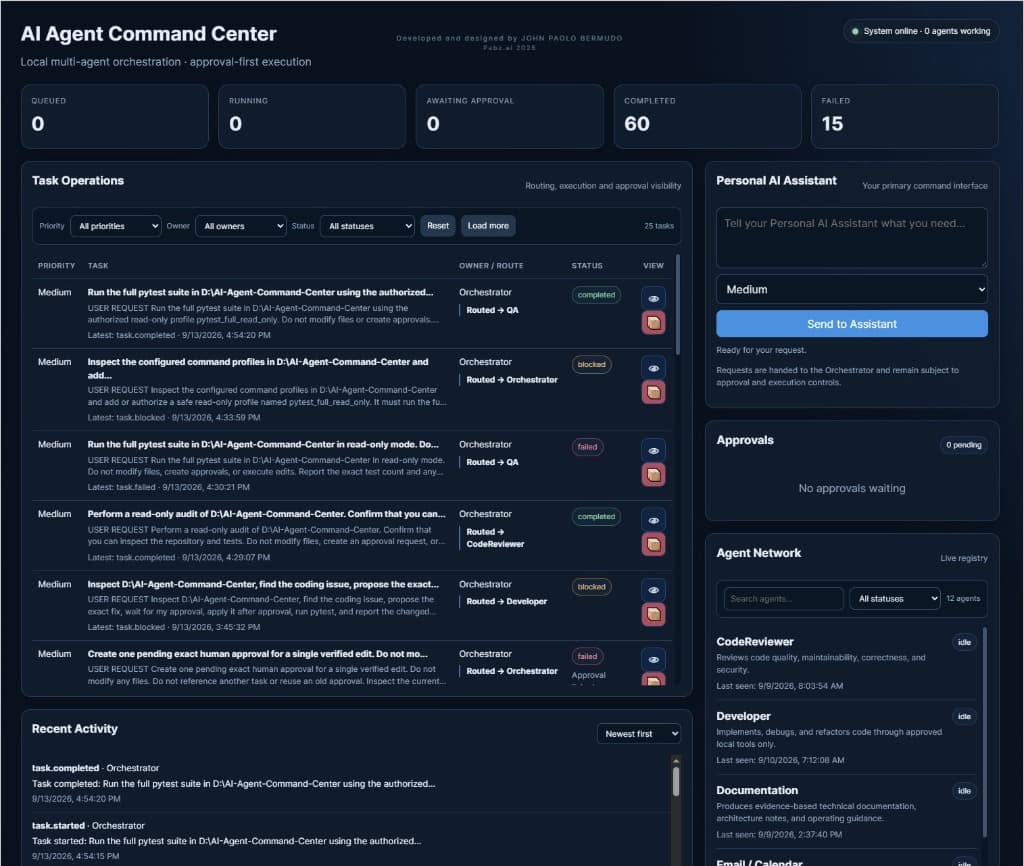
Personal AI Orchestration, Multi-Agent Coordination & Approval-First Local Execution
The AI Agent Command Center is a personal AI orchestration platform designed to transform a conventional computer into a structured AI-assisted working environment.
My ultimate vision for this project is true autonomous leverage: having multiple specialized AI agents working continuously on my personal projects 24/7 on my dedicated desktop server, running the show and making tangible progress even while I am sleeping.
Rather than relying on one general-purpose chatbot, the platform uses a Personal AI Assistant, an Orchestrator, specialized AI agents, persistent task management, controlled execution, human approval gates, verification, and auditability.
"AI can reason and propose. The system decides what it is authorized to execute."
— Core Principle
The Problem vs. The Solution
Conventional AI assistants normally follow a simple conversational loop: USER → LLM → RESPONSE. The goal of this project was to move from "AI that answers" toward "AI that coordinates controlled work."
The solution is an operational architecture that routes natural language through a multi-agent system, gating sensitive actions behind a control layer.
Personal AI Assistant
The primary human interface. Instead of manually selecting components, users provide natural-language intent. For example: "Review my application, investigate the issue, fix it if authorized, run tests, and report." The system then coordinates the workflow.
The Orchestrator
The coordination layer. It determines how work should be routed rather than performing specialist functions itself. It delegates exact tasks (e.g., Orchestrator → QA or Orchestrator → Developer). Coordination ≠ Specialization.
LLM Intelligence Layer
The LLM provides reasoning, planning, code analysis, and structured proposals. Crucially, the LLM is deliberately separated from unrestricted execution authority. It can only propose actions to the Control Layer.
The 12-Agent Specialist Network
A live registry of specialized AI agents built to handle focused domain workflows rather than relying on a single monolithic prompt.
Orchestrator
Coordinates tasks and routing.
Developer
Implements, debugs, and refactors approved local code.
CodeReviewer
Reviews code quality, maintainability, and correctness.
QA
Runs tests, validates behavior, and analyzes regressions.
SecurityReviewer
Reviews security controls and authorization boundaries.
UIUX
Reviews interface structure and usability.
Documentation
Produces technical and architectural documentation.
Research / News
Handles controlled research workflows.
HR & Compliance
Supports structured HR and compliance analysis.
Job Tracker
Tracks opportunities and applications.
Executive Assistant
Supports planning, organization, and summarization.
Email / Calendar
Provides controlled communication scheduling.
Approval-First Security
The system distinguishes between safe operations and sensitive/consequential operations. Sensitive actions require explicit human approval before execution.
This architecture is designed around task-scoped exact authorization rather than treating a generic "approved" response as unrestricted permission.
Persistent Task Operations & Traceability
Work is represented as persistent operational tasks rather than disposable chat messages, backed by SQLite. This ensures total observability.
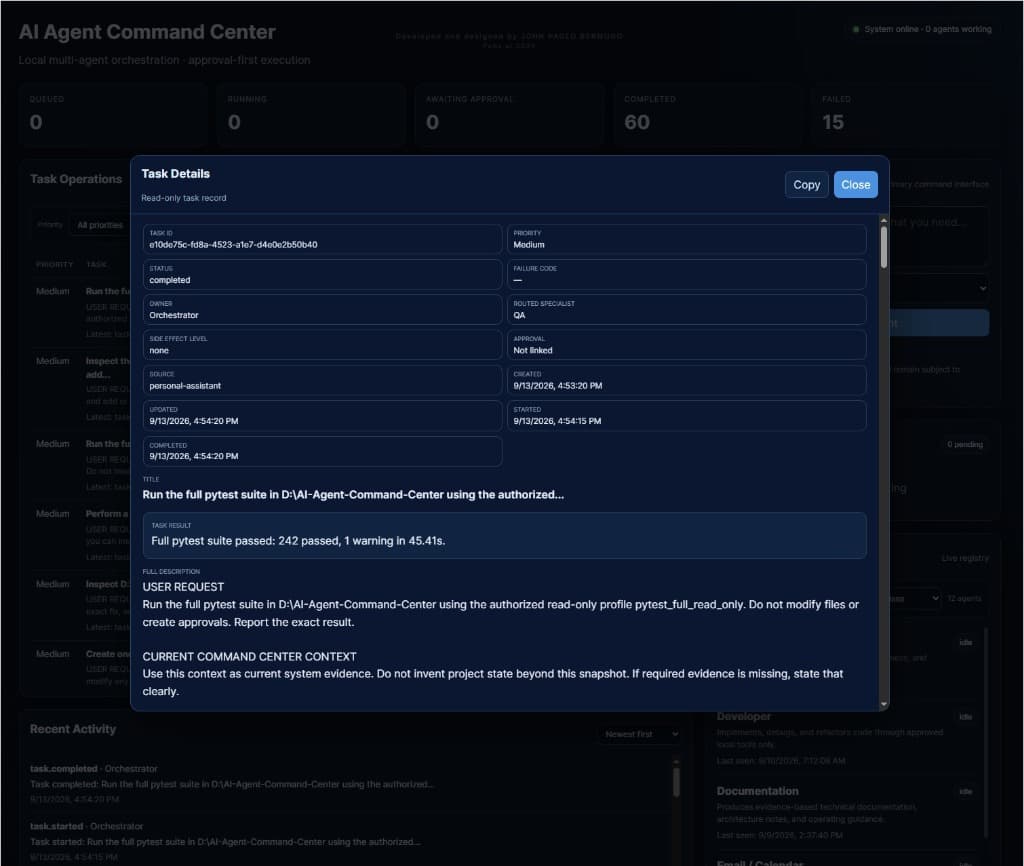
Task Details & Traceability
Users can determine exactly what was requested, who handled it, what happened, whether approval was required, and what result was produced.
- Task ID & Priority
- Status (QUEUED, RUNNING...)
- Owner & Routed Specialist
- Side Effect Level
- Approval & Source
- Precise Timestamps
Activity & Auditability
The system records every task lifecycle event (e.g., task.started, task.requeued, task.completed), providing deep observability into autonomous and semi-autonomous workflows.
Recovery-Oriented Design
If the system is interrupted, task states are recovered from persistence. Safe work can be requeued, while sensitive operations are never blindly replayed.
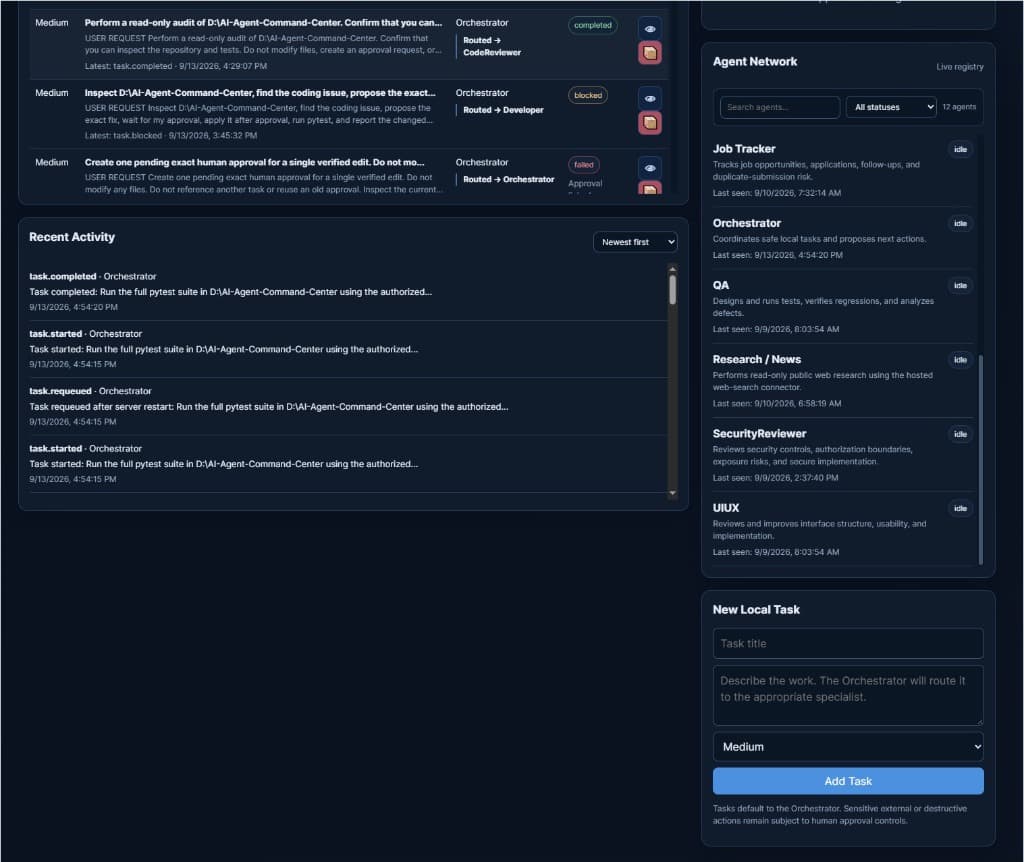
Engineering Metrics
Based on the captured active development state of the system.
Technology Stack & Architecture
This project explores how an AI system can move beyond answering questions and begin coordinating useful work while retaining human authority, security boundaries, and persistent state. The objective is NOT to turn the LLM itself into the OS, but to create a controlled AI operations layer around the computer.
Future Roadmap: Remote Mobile Access
The next evolution of the AI Agent Command Center is untethering the approval layer from the physical machine.
I am designing a secure mobile application companion. As long as the dedicated desktop server is running at home, I will be able to receive push notifications for required approvals on my phone, issue new commands remotely, and monitor task progress from anywhere in the world—maintaining total control without being at my desk.